
A scalable model that grows with every home.
We separate day-to-day control of the home from the home as a financial asset. We use this to stabilise rents and grow our collective influence on the system by securing more homes.

The financial and legal scaffold that makes it possible
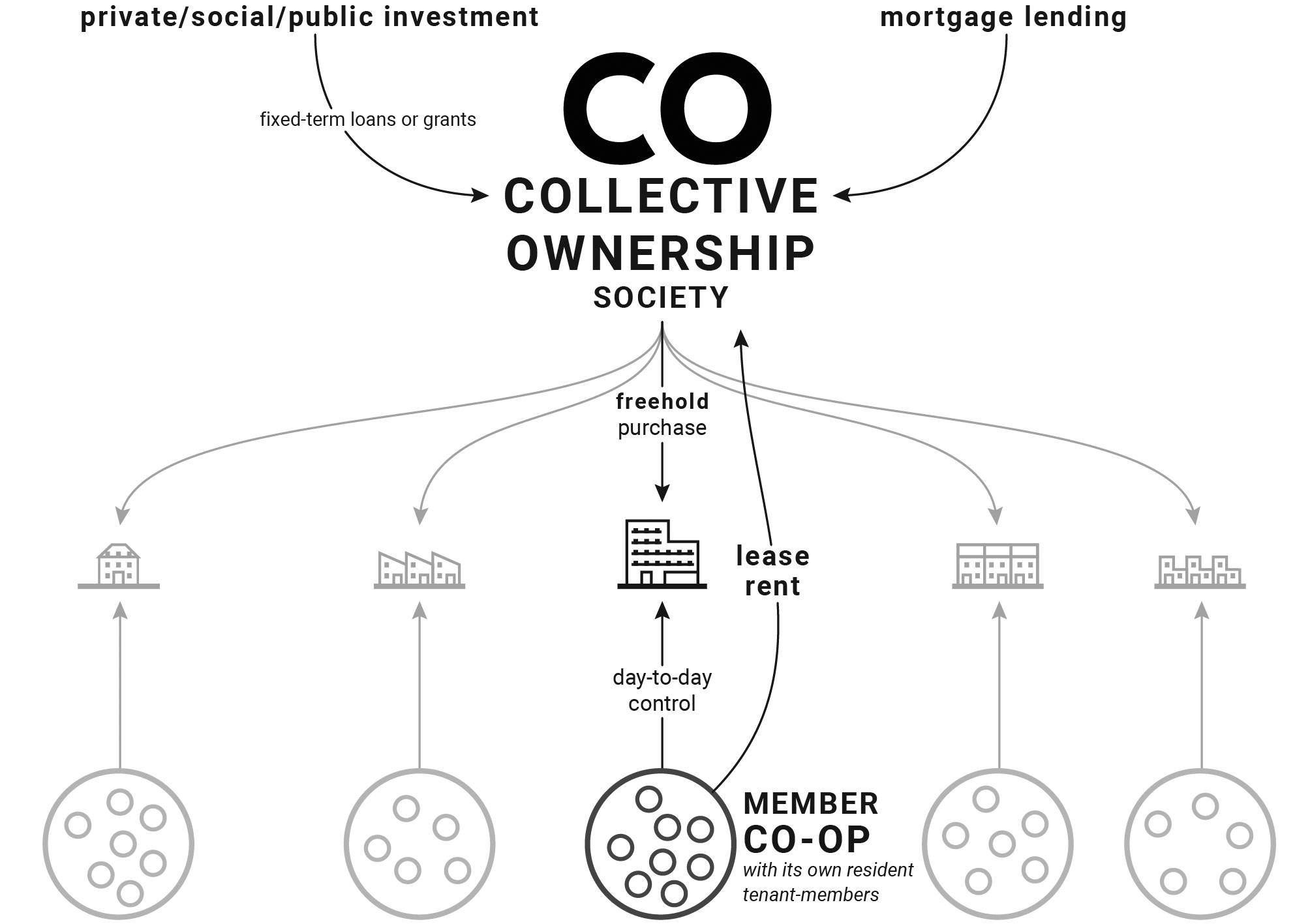
Investors
Provide capital
Individuals, organisations, and residents have flexible investment options
Collective Ownership
Acquires properties
Professional Board with residents, experts & investors.
Member Co-op residents
Lease & control
Organised as housing co-ops. Surplus funds more homes.
Walkthrough
The Journey
Collective Ownership raises capital
Investment from individuals, organisations and residents - flexible terms, high social impact.
It acquires properties in bulk
New build or existing stock. Often identified by member co-op groups. Over time our scale unlocks better leverage and bank finance.
Properties are leased to a Co-op
Residents organised as a housing co-op and member-owners of the Society.
Residents control day-to-day
Maintenance, new residents, how rent is apportioned - are all democratically decided by resident communities. Each has their unique character and values.
Lease rent funds more homes
Not for profit. Surplus is recycled to grow the portfolio of secure, democratically-controlled homes.
Works with new build and existing stock
Caters for a broad range of households seeking security, stability, and belonging

Shared House
- resident controlled House in Multiple Occupation
- general meeting governed
- self-managed
- organically formed group
- market purchase

Small block /
Villa
- self contained dwellings in the same building
- general meeting governed
- self-managed
- organically formed group (could include TA residents)
- development purchase

Large Block /
Cohousing
- self contained dwellings in the same scheme
- committee governed
- outsourced management
- organic seed with recruitment
- development agreement

Scattered /
Local Area
- self contained dwellings in the same part of town
- committee governed
- outsourced management
- assembled residents (including TA residents)
- gradual market purchase or donations/ bequests
FAQ
Download our detailed questions
What is a Housing Co-operative?
A housing co-operative is a group of residents who collectively manage their own housing. Instead of having a private landlord, residents form a legal organisation (a co-operative society) where everyone who lives there is both a member and a tenant. This means you're essentially your own landlord, together with your neighbours — you democratically make decisions about repairs, maintenance, who moves in, and how the co-op is run. The co-operative operates as a non-profit, so there is never an incentive to charge more rent than necessary and any surplus goes back into maintaining and improving your homes rather than to profit an external landlord. The co-operative might own the properties outright (freehold) or lease them from another organisation, but either way, residents remain in full control of their housing.
How does the Collective Ownership model work?
Collective Ownership aims to make not-for-profit resident-controlled housing more widely available in the UK, by scaling up housing co-operatives. The approach bridges the gap between the private rented sector, home ownership, and social housing. The model hinges on separating the functions of:day-to-day housing management and the lived experience, which is kept in the hands of residents organised as small housing co-operatives (Member Co-ops), andraising and managing funds for property acquisition to expand the number of homes in collective ownership. This is the role of the Collective Ownership Society.The Collective Ownership Society (COS) is a professionally run organisation which purchases properties to lease on to groups of residents organised as housing co-operatives (the Member Co-ops). COS focuses on raising investment and mutualising assets to deliver growth and affordability. Properties are held long term to leverage economic power while Member Co-ops have direct control over the management of their homes.
How is the Collective Ownership Society incorporated?
The Collective Ownership Society (COS) is incorporated as a fully mutual ‘secondary’ housing co-operative, where all the member-tenants are housing co-ops (Member Co-ops) and not individuals. In other words, COS is “a co-op of co-ops”. As such, COS is not-for-profit and democratically controlled. Each Member Co-op has a say on how COS is run.
Why become a member of Collective Ownership?
The Collective Ownership Society (COS) offers a fundamentally different approach to housing: one based on co-operation, not competition. When you join as a member co-operative, you're not just solving your own housing problem - you're strengthening an entire movement. Each new member co-op makes Collective Ownership stronger:More member co-ops strengthen the entire entity, allowing us to purchase more properties more quicklyA growing network strengthens our profile with funders, lenders, and policymakers, furthering COS’ mission to provide secure, co-operative housing at scaleEach housed group generates revenue that helps house the next co-operativeYour participation builds the evidence base for an alternative housing modelJoining as a member does not guarantee the COS will be able to purchase a property for your co-op, as this will depend on project viability and available resources. Although you may not be housed immediately, by joining as a member, you actively contribute to speeding up acquisitions for all groups. This is co-operation in action — working together to ensure everyone has access to secure, co-operative housing.
How can my group or co-op become a member?
We are happy to talk to groups before they become formal members. Contact us with a few details if you have a property in mind or savings to invest. If you are yet to form your co-op, we can provide guidance on incorporation. An incorporated co-op can become a member of COS as a prospective tenant for a period of two years, allowing time to find and secure a property, by completing the Membership Application form.
Can we set up a housing co-op without Collective Ownership?
Yes, but it has proven to be difficult. New co-ops face high property prices, can't access good financing terms and face expensive, piecemeal funding. Much of their rent goes to servicing high-cost debt rather than keeping housing affordable. A big driver to devising Collective Ownership was for more renters to be able to take control of their own homes, by making it easier to set up a housing co-op. Collective Ownership is well placed to provide the financial infrastructure and scale that individual co-ops lack, securing better financing, to move quickly on property purchases, and reinvest surpluses into acquiring more homes for more co-ops. The COS can also cover all the costs involved in financial modelling, legal work, and surveys.
Do we need money to work with Collective Ownership?
No, but if your group has access to some capital that can be invested, or access to a particular grant or donation, this can be ringfenced for a property to be leased to your co-op. Depending on the amount and the terms, it can help make a project viable or make the starting rents lower. See the FAQs on investment.
Why can’t our co-op own the property directly?
In a way your co-op owns the property as a member of COS, along with all other member co-ops. Mutualising ownership in this way, makes for a stronger entity and means that each project contributes to changing the market as a whole, and not just their own housing situation. Where individual co-ops own their properties, they have tended to do very little in terms of growth and expansion, for various reasons. This locks the potential benefits within the individual co-op rather than expanding affordable housing and resident-control to others. Even if a new co-op has plans for expanding as the mortgage is paid down, this is typically decades away, when the membership, capacity and ambition may have changed. Collective Ownership is designed to ensure mutualisation and growth takes place, and to make the most of assets by professionally leveraging them for further growth.
Why is there a lease? That doesn’t sound very secure.
A 5-year “short” lease means the property interest (value of a capital asset) sits with the COS, allowing it to leverage better borrowing terms, so that all member co-ops benefit, and more co-operative homes can be provided. The lease will typically be renewed automatically, unless there is a good reason not to renew, such as major or consistent breaches of the lease contract, or governance issues in your co-op which are not addressed. The COS Board’s decision not to renew a lease can be overturned at a Special General Meeting by a majority of Member Co-ops, so there is a mutual check and balance on COS Board actions from other member co-ops. This is something that is not found with other landlords and represents the ultimate collective control of members and residents.